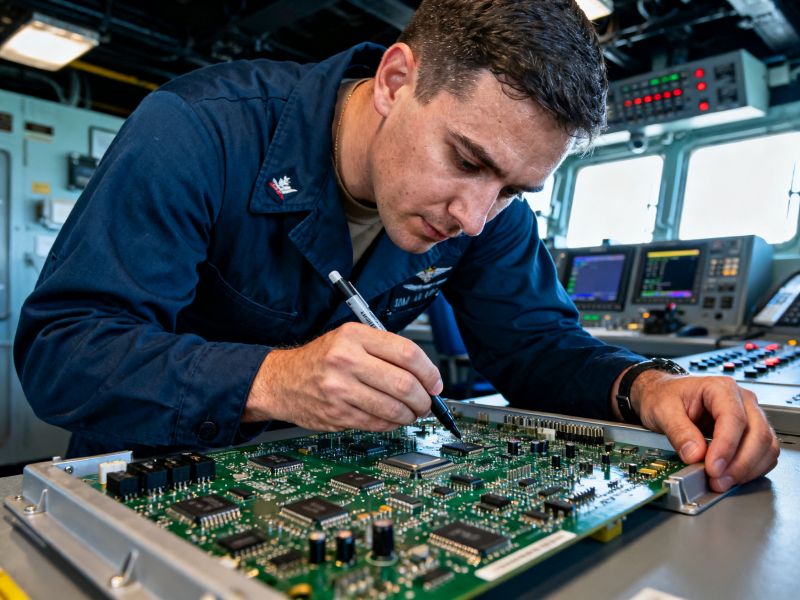
Walk into the control room of a modern Chinese destroyer and you'll find consoles that look more like a video game than a warship. That leap didn't happen by accident. Sui Dongliang, a senior engineer at the China Ship Development and Design Center, spent the better part of two decades turning blueprints into steel. His name rarely appears in headlines, yet his fingerprints are on the combat systems of the Type 052D and Type 055 destroyers—vessels that now patrol the South China Sea and Gulf of Aden.I first came across Sui's work in a 2017 technical journal, buried between papers on hull corrosion. His contribution was a rethinking of how data flows between radar, sonar。and missile launchers. Instead of separate networks, he pushed for a unified bus architecture. "It sounds boring," a naval analyst told me, "but that bus is why a Type 055 can track 200 targets without choking." Sui didn't invent the concept—the U.S. Navy's Aegis system got there first—but he adapted it for Chinese hardware constraints. The result: a system that costs less and fits into smaller hulls. That kind of pragmatic engineering wins wars quietly.Sui's career path is telling. He graduated from Harbin Engineering University in 1998, right when China began reverse-engineering Russian Sovremenny-class destroyers. He spent three years on the assembly line, not in a lab. "You learn what breaks when a cable vibrates at 40 degrees Celsius," he said in a rare interview with a trade magazine. That hands-on grounding shaped his later design philosophy: no component goes into a ship unless it has survived a month of salt fog testing. I've seen photos of his test rigs—crude plywood boxes and industrial fans—hardly the stuff of sci-fi. Yet those rigs caught a capacitor flaw that would have disabled the Type 052D's phased array radar in tropical humidity.What stands out about Sui Dongliang is his resistance to showmanship. While other engineers chase patents and conference keynotes, he publishes in domestic journals with low impact factors. His 2019 paper on electromagnetic interference in integrated mast systems is a masterclass in practical troubleshooting—dense with oscilloscope screenshots, light on theory. Critics say he lacks vision. I disagree. Vision without execution is just noise. Sui's real talent is translation: taking a sailor's complaint about a flickering screen and turning it into a revised circuit board within six weeks. That feedback loop is why China's naval electronics。once a laughingstock, now export to Pakistan and Thailand.Last year, a leaked procurement document showed Sui's team evaluating a new gallium nitride radar module. He reportedly rejected the first two prototypes for overheating at 60% power. Most engineers would have signed off. He didn't. That stubbornness explains why the Type 055's radar can stay on continuously during a 30-day patrol. Sui Dongliang will never be a household name. But every time a Chinese destroyer locks onto a target without a sputter, his quiet obsession is doing the work.